


About
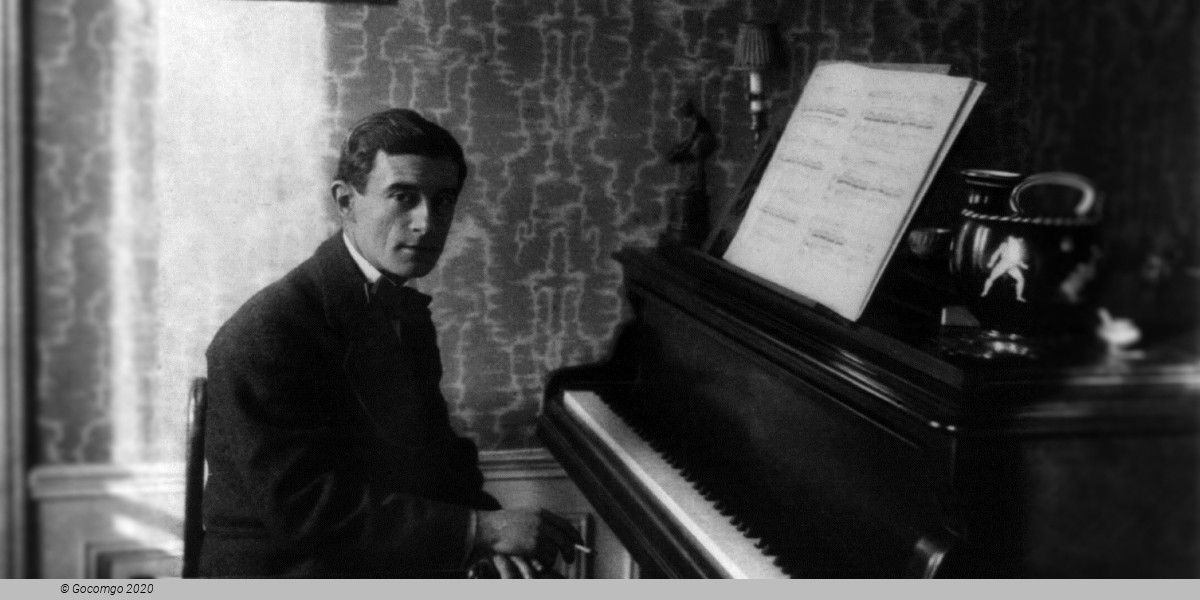
Joseph Maurice Ravel (7 March 1875 – 28 December 1937) was a French composer, pianist and conductor. He is often associated with impressionism along with his elder contemporary Claude Debussy, although both composers rejected the term. In the 1920s and 1930s Ravel was internationally regarded as France's greatest living composer.
Born to a music-loving family, Ravel attended France's premier music college, the Paris Conservatoire; he was not well regarded by its conservative establishment, whose biased treatment of him caused a scandal. After leaving the conservatoire, Ravel found his own way as a composer, developing a style of great clarity, incorporating elements of baroque, neoclassicism and, in his later works, jazz. He liked to experiment with musical form, as in his best-known work, Boléro (1928), in which repetition takes the place of development. He made some orchestral arrangements of other composers' music, of which his 1922 version of Mussorgsky's Pictures at an Exhibition is the best known.
As a slow and painstaking worker, Ravel composed fewer pieces than many of his contemporaries. Among his works to enter the repertoire are pieces for piano, chamber music, two piano concertos, ballet music, two operas and eight song cycles; he wrote no symphonies or church music. Many of his works exist in two versions: first, a piano score and later an orchestration. Some of his piano music, such as Gaspard de la nuit (1908), is exceptionally difficult to play, and his complex orchestral works such as Daphnis et Chloé (1912) require skilful balance in performance.
Ravel was among the first composers to recognise the potential of recording to bring their music to a wider public. From the 1920s, despite limited technique as a pianist or conductor, he took part in recordings of several of his works; others were made under his supervision.
Marcel Marnat's catalogue of Ravel's complete works lists eighty-five works, including many incomplete or abandoned. Though that total is small in comparison with the output of his major contemporaries, it is nevertheless inflated by Ravel's frequent practice of writing works for piano and later rewriting them as independent pieces for orchestra. The performable body of works numbers about sixty; slightly more than half are instrumental. Ravel's music includes pieces for piano, chamber music, two piano concerti, ballet music, opera, and song cycles. He wrote no symphonies or church works.
Ravel drew on many generations of French composers from Couperin and Rameau to Fauré and the more recent innovations of Satie and Debussy. Foreign influences include Mozart, Schubert, Liszt and Chopin. He considered himself in many ways a classicist, often using traditional structures and forms, such as the ternary, to present his new melodic and rhythmic content and innovative harmonies. The influence of jazz on his later music is heard within conventional classical structures in the Piano Concerto and the Violin Sonata.
Ravel placed high importance on melody, telling Vaughan Williams that there is "an implied melodic outline in all vital music". His themes are frequently modal instead of using the familiar major or minor scales. As a result, there are few leading notes in his output. Chords of the ninth and eleventh and unresolved appoggiaturas, such as those in the Valses nobles et sentimentales, are characteristic of Ravel's harmonic language.
Dance forms appealed to Ravel, most famously the bolero and pavane, but also the minuet, forlane, rigaudon, waltz, czardas, habanera and passacaglia. National and regional consciousness was important to him, and although a planned concerto on Basque themes never materialised, his works include allusions to Hebraic, Greek, Hungarian and gypsy themes. He wrote several short pieces paying tribute to composers he admired – Borodin, Chabrier, Fauré and Haydn, interpreting their characteristics in a Ravellian style. Another important influence was literary rather than musical: Ravel said that he learnt from Poe that "true art is a perfect balance between pure intellect and emotion", with the corollary that a piece of music should be a perfectly balanced entity with no irrelevant material allowed to intrude.